
Mission proposal · ESA M8 · Phase 0
FOSSIL
A space mission proposed to ESA, now in Phase 0 study, to measure spectral distortions of the Cosmic Microwave Background and open a new observational window on the early Universe.
Building on the legacy of COBE/FIRAS, FOSSIL is designed to map the spectrum of the sky with almost three orders of magnitude more sensitivity, to probe inflation, dark matter, black hole origins and the thermal history of the cosmos.
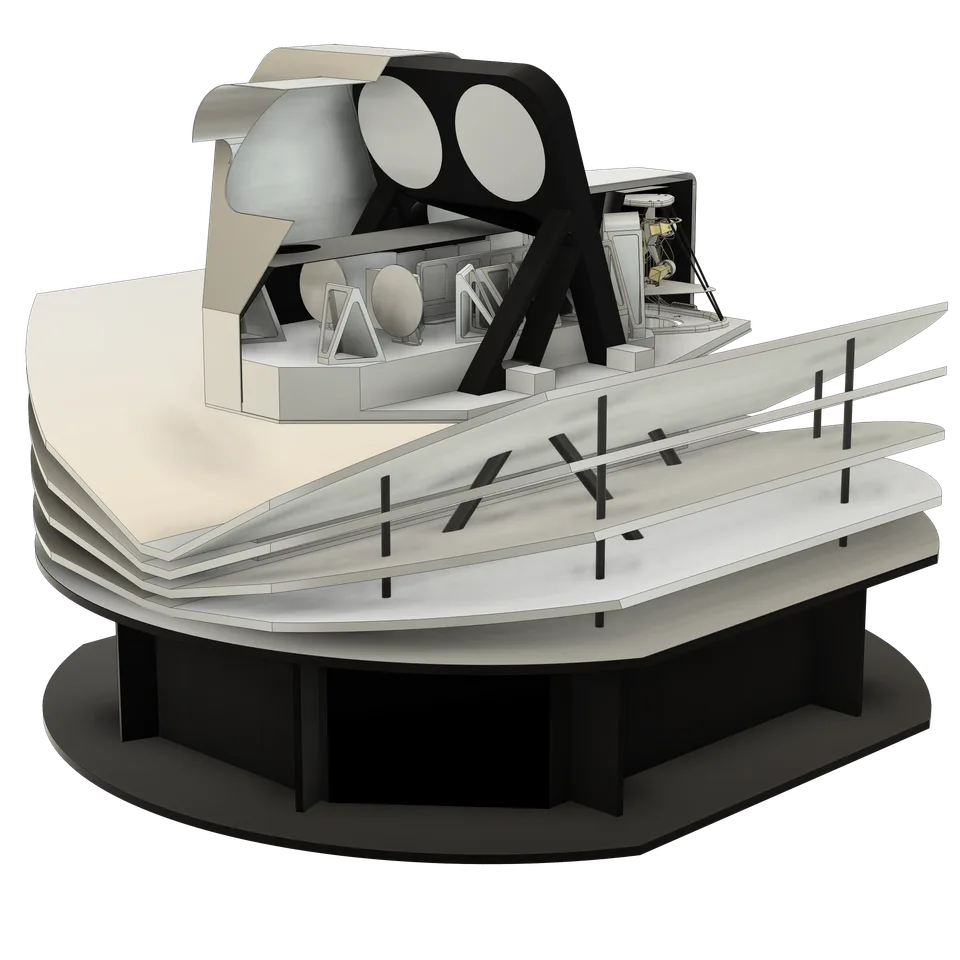
Design goals of the proposed mission
The mission
Reading the oldest light
FOSSIL (FTS fOr CMB Spectral diStortIon expLoration) is a space mission proposed to the European Space Agency for its 8th Medium-class mission opportunity (M8). It is one of the candidates in Phase 0, ESA's first assessment of the proposals.
Thirty years after NASA's COBE/FIRAS, FOSSIL aims to deliver the first unambiguous measurement of spectral distortions of the Cosmic Microwave Background (CMB) — tiny, physics-rich departures of the CMB from a perfect blackbody spectrum that trace processes far beyond the reach of the CMB temperature anisotropies mapped by WMAP and Planck.
The instrument
How it would work
As proposed, FOSSIL would measure the sky with a differential, dual-input, dual-output polarising Fourier Transform Spectrometer (FTS) — the technique pioneered by COBE/FIRAS, pushed nearly three orders of magnitude further in sensitivity. The instrument would compare the sky against a thermally controlled internal blackbody reference across 130 channels spanning 50 GHz to 2 THz, cooled to 4.5 K, with Kinetic Inductance Detectors operating at 50 mK.
Science
Science goals
CMB spectral distortions provide an independent, uniquely powerful probe of the early Universe, dark matter, and the thermal history of cosmic structures — reaching scales and epochs inaccessible to CMB anisotropy measurements alone.
Primary goals
The core science objectives the mission is designed around.
Inflation and the early Universe
Measure the µ distortion left by the damping of primordial fluctuations on scales of 10 to 10⁴ Mpc⁻¹, a test of inflation independent of B-mode searches, and trace any energy released between nucleosynthesis and recombination.
Nature of dark matter
Look for the heating that dark-matter annihilation, decay or scattering would leave in µ and y distortions, constraining particle mass, lifetime, kinetic mixing and cross section at epochs no laboratory can reach.
Origin of black holes
Test whether supermassive black holes grew from primordial or direct-collapse seeds, which can leave sizeable µ distortions, complementing the gravitational waves seen by pulsar timing arrays and, later, LISA.
Cosmic thermodynamics
Take a census of hot gas through the y distortion and its relativistic correction, to constrain the energy injected by supernova and AGN feedback, and the reionisation of the Universe.
Secondary goals
Additional science enabled by the wide frequency coverage, from 50 GHz to 2 THz.
Distortions beyond the average
Degree-resolution maps of distortion anisotropies, cross-correlated with CMB temperature and polarisation, and multi-frequency tests of the lack of power at the lowest multipoles first seen by COBE.
Star-formation history
An absolute measurement of the Cosmic Infrared Background to sub-percent precision, quantifying the star formation hidden by dust across cosmic history.
Line-intensity mapping
With 15 GHz spectral resolution, the integrated CO and [CII] line emission of galaxies at cosmic noon (1 ≤ z ≤ 4): a census linking gas content to star formation.
Galactic dust and foregrounds
Dust temperature to the millikelvin and dust spectra to sub-percent precision, to discriminate between Galactic foreground models, with maps of bright lines such as CO, C i, C ii, N ii and O i.
Roadmap
Mission timeline
-
2026
Proposal to ESA
FOSSIL answers ESA's call for its 8th Medium-class mission (M8).
-
Now
Phase 0 study
ESA's first assessment of the candidate missions for M8. Further studies and selections follow before a mission is chosen, then adopted.
-
~2041
Possible launch
If FOSSIL is selected: a four-year survey of the whole sky from an orbit around the L2 point.
People
The consortium
Scientists and engineers from institutes across Europe and beyond prepare FOSSIL together. The map shows where the members of the consortium work.
Loading the map…
Questions
Is FOSSIL an approved ESA mission?
Not yet. FOSSIL has been proposed for ESA's 8th Medium-class mission opportunity (M8) and is in Phase 0, ESA's first assessment of the candidate missions. Several study phases and selections come before a mission is chosen, then adopted for development.
What is the Cosmic Microwave Background?
The oldest light in the Universe, released about 380,000 years after the Big Bang. It fills the whole sky and today has a temperature of 2.7 K.
What is a spectral distortion?
A tiny departure of the CMB from a perfect blackbody spectrum, left by processes that injected energy into the young Universe. FOSSIL aims to measure them about a thousand times more precisely than COBE/FIRAS.
Where would FOSSIL observe from?
As proposed, from an orbit around the L2 point, about 1.5 million km from Earth, scanning the whole sky every six months.
News
Latest news
Announcements from the collaboration.
Loading…
Publications
Peer-reviewed papers and preprints from the collaboration.
Loading…